Understanding the inner mechanics of blockchain technology—from
blocks and hashes to consensus mechanisms and nodes.
📦 What is a Block?
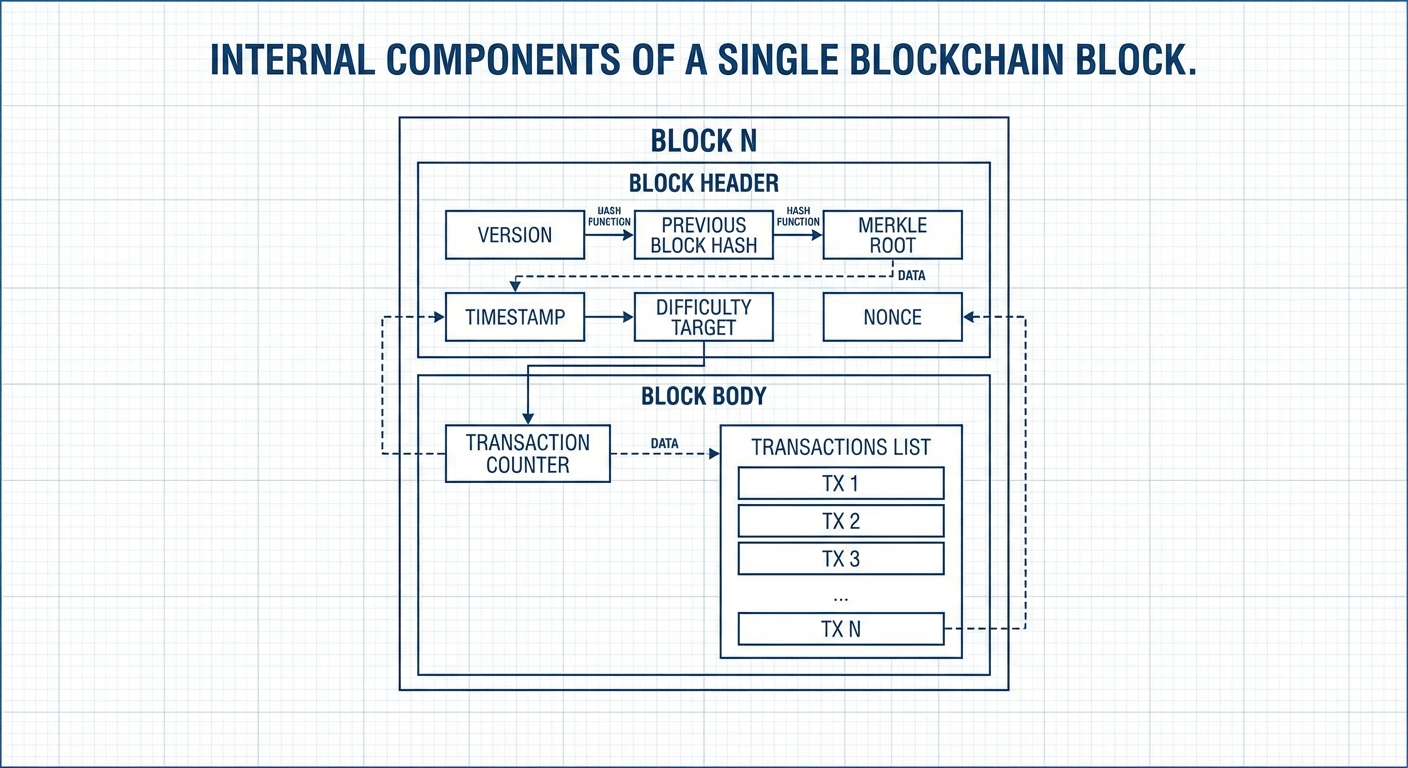
A block is a container that holds a batch of verified transactions.
Think of each block as a page in a ledger book. Once the page is full, it gets
permanently added to the book.
What’s Inside a Block?
Every block contains several pieces of important data:
Anatomy of a Block
Component
Description
Example
Block Number
The position of the block in the chain
Block #782,451
Timestamp
When the block was created
2025-01-15 14:23:07 UTC
Transaction Data
List of transactions in this block
Alice sends 0.5 BTC to Bob
Previous Hash
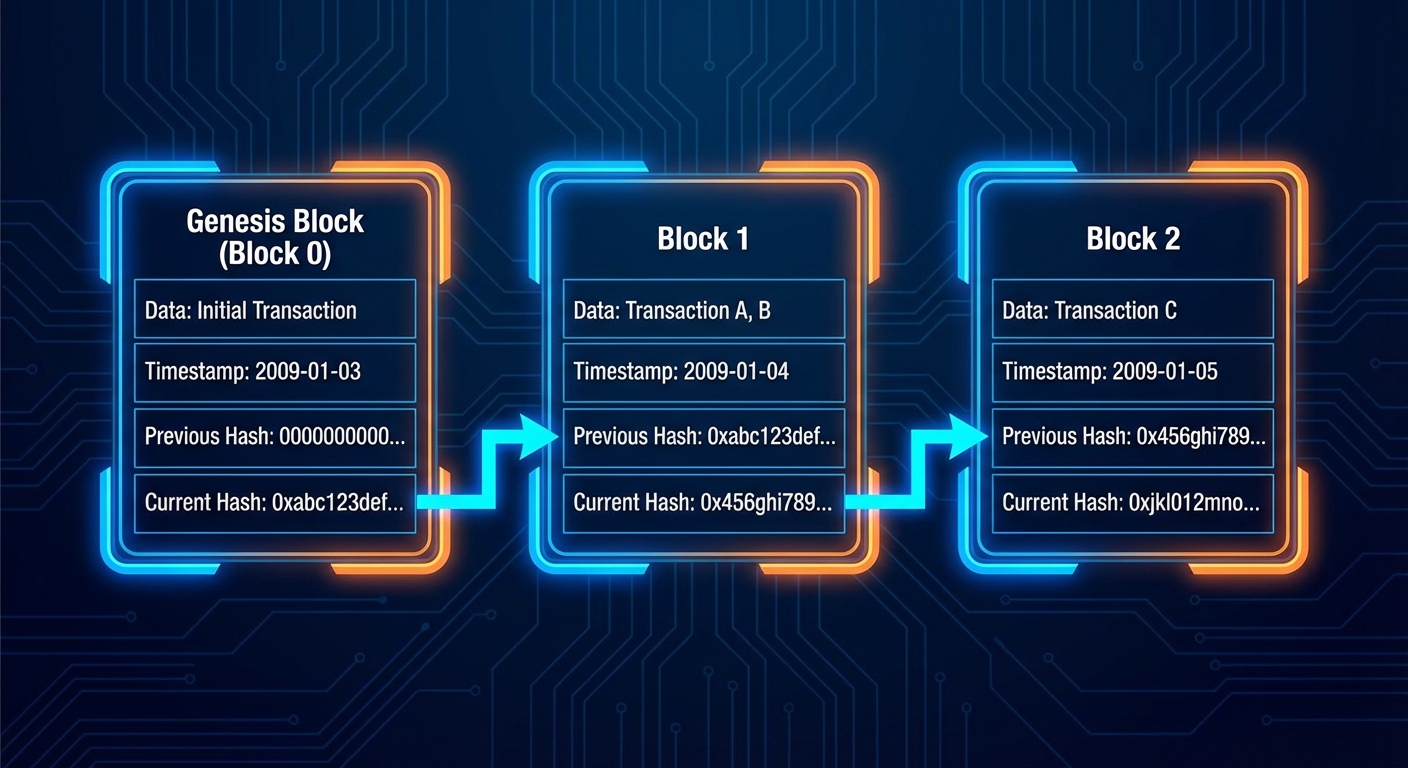
Hash of the previous block (creates the chain!)
00000a3b7c8d...
Current Hash
This block’s unique fingerprint
00000f9e2a1b...
Nonce
A number miners adjust to find a valid hash
2,874,192
Merkle Root
A hash summary of all transactions in the block
8a4c2e7f...
Figure: The anatomy of a blockchain block💡 What is a Merkle Root?
A Merkle Root (named after Ralph Merkle) is created by hashing pairs of
transactions together repeatedly until only one hash remains. It’s like a
summary fingerprint of all the transactions in a block. If even one
transaction changes, the Merkle Root completely changes—making tampering
immediately detectable.
🔏 Hashing Explained
A hash is a fixed-length string of characters generated by a hash function.
It acts as a digital fingerprint for any piece of data.
Properties of a Good Hash Function
Deterministic – Same input always produces the same output
Fast to compute – Generating a hash is quick
One-way – You can’t reverse-engineer the input from the hash
Avalanche effect – A tiny change in input creates a completely different hash
Collision resistant – Nearly impossible for two different inputs to produce the same hash
Hash Examples (SHA-256)
Bitcoin uses the SHA-256 hash function. Notice how a tiny change produces a completely different result:
Block #4 stores Block #3’s original hash—now there’s a mismatch
Block #4 becomes invalid, and so does Block #5, #6, and every block after it
The network rejects the tampered chain
"To alter a single block, you’d have to recalculate every block that
comes after it—and do it faster than the entire rest of the network.
That’s practically impossible."
This is what makes blockchain immutable—once data is recorded,
it’s there permanently.
🖥 Nodes & The Network
A node is any computer that participates in the blockchain network.
Nodes work together to maintain and validate the blockchain.
Types of Nodes
💻 Full Node
Stores a complete copy of the entire blockchain. Validates all
transactions and blocks. Acts as the backbone of the network.
⚡ Light Node (SPV)
Stores only block headers, not full transaction data. Relies on full
nodes for verification. Uses less storage and bandwidth.
⛏ Mining Node
Competes to create new blocks by solving mathematical puzzles.
Receives block rewards (new coins) when successful.
📡 Archive Node
Stores everything a full node does, plus historical state data.
Used by block explorers and analytics services.
🤝 Consensus Mechanisms
Since there’s no central authority, the network needs a way to agree
on which transactions are valid. This is called a consensus mechanism.
Major Consensus Mechanisms
Consensus Mechanisms Compared
Mechanism
How It Works
Used By
Energy Use
Speed
Proof of Work (PoW)
Miners solve complex math puzzles
Bitcoin, Litecoin
Very High ⚠
Slow (~10 min/block for Bitcoin)
Proof of Stake (PoS)
Validators stake coins as collateral
Ethereum, Cardano
Very Low ✅
Fast (~12 sec/block for Ethereum)
Delegated Proof of Stake (DPoS)
Token holders vote for delegates to validate
EOS, Tron
Low
Very Fast
Proof of Authority (PoA)
Pre-approved validators based on identity
VeChain
Very Low
Very Fast
💡 PoW vs PoS: An Analogy
Proof of Work is like a race: thousands of miners compete to solve a
puzzle first. Only the winner gets the reward. It requires enormous computing power.
Proof of Stake is like a lottery: validators are chosen randomly, but
those with more coins staked have a higher chance. Much less energy is wasted.
🔄 The Life of a Transaction
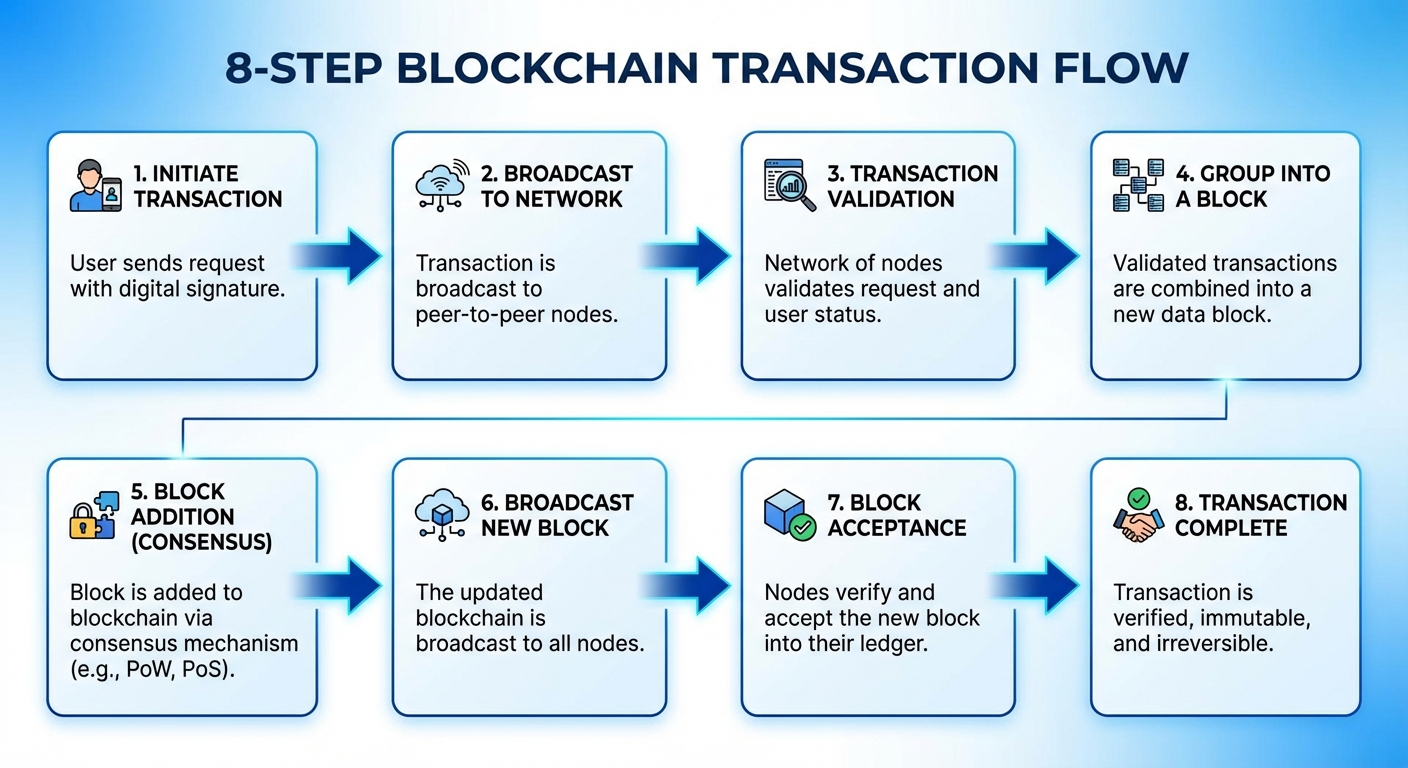
Here’s what happens step-by-step when Alice sends 1 BTC to Bob:
Alice initiates the transaction She uses her wallet to create a transaction: "Send 1 BTC to Bob’s address."
Transaction is signed Alice’s private key digitally signs the transaction, proving she authorized it.
Broadcast to the network The signed transaction is sent to the blockchain network and enters the mempool
(a waiting area for unconfirmed transactions).
Validation by nodes Nodes verify that Alice has enough BTC and that the signature is valid.
Included in a block A miner (or validator) bundles the transaction with others into a new block.
Consensus is reached The network agrees that the new block is valid.
Block is added to the chain The new block becomes a permanent part of the blockchain.
Bob receives the BTC Bob’s wallet reflects the new balance. The transaction is complete! ✅
Figure: The lifecycle of a blockchain transaction
🛡 Why Blockchain is Secure
Blockchain achieves security through multiple layers:
Security Layers of Blockchain
Layer
How It Protects
Cryptographic Hashing
Any change to data changes the hash, making tampering immediately visible
Chain Linking
Changing one block invalidates all subsequent blocks
Decentralization
No single point of failure—thousands of copies exist worldwide
Consensus Mechanism
Majority of the network must agree on changes
Digital Signatures
Only the owner of a private key can authorize transactions
⚠ What is a 51% Attack?
A 51% attack occurs when a single entity gains control of more than
50% of the network’s computing power (or staked coins). They could
theoretically reverse transactions or double-spend. However, for large
networks like Bitcoin, this would require billions of dollars in
hardware and electricity, making it practically impossible.