Mining is the process by which new transactions are verified and added to
the blockchain, and new coins are created. It’s the backbone
of Proof of Work blockchains like Bitcoin.
💡 What is Mining?
Despite the name, cryptocurrency mining has nothing to do with pickaxes or caves!
Mining is the process of using computer power to:
Validate pending transactions
Bundle them into a new block
Solve a cryptographic puzzle to earn the right to add the block
Receive a reward in cryptocurrency
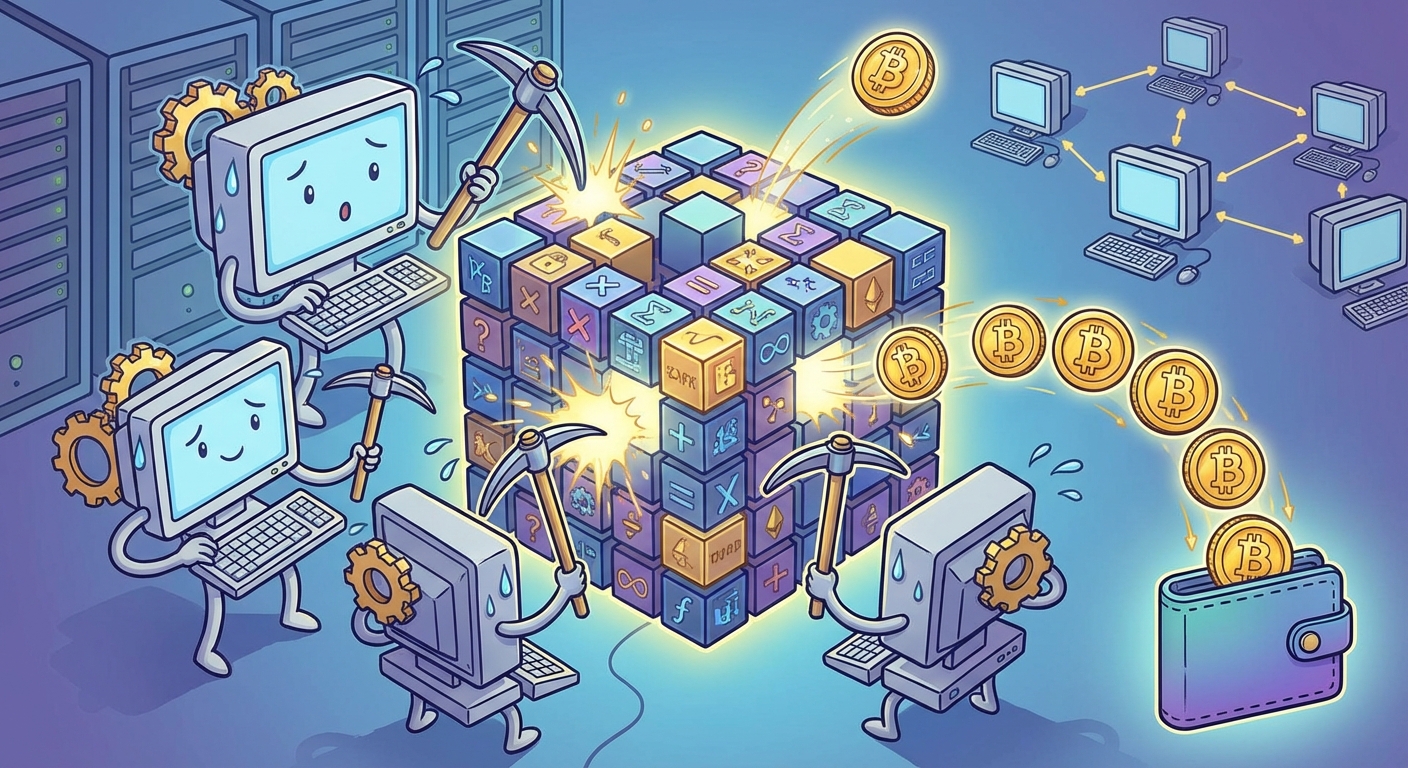
“Think of mining like a giant, global math competition. Thousands of
computers race to solve a puzzle. The winner gets to add the next page
to the ledger and earns a prize.”
Figure: Cryptocurrency mining concept
⚙ How Mining Works – Step by Step
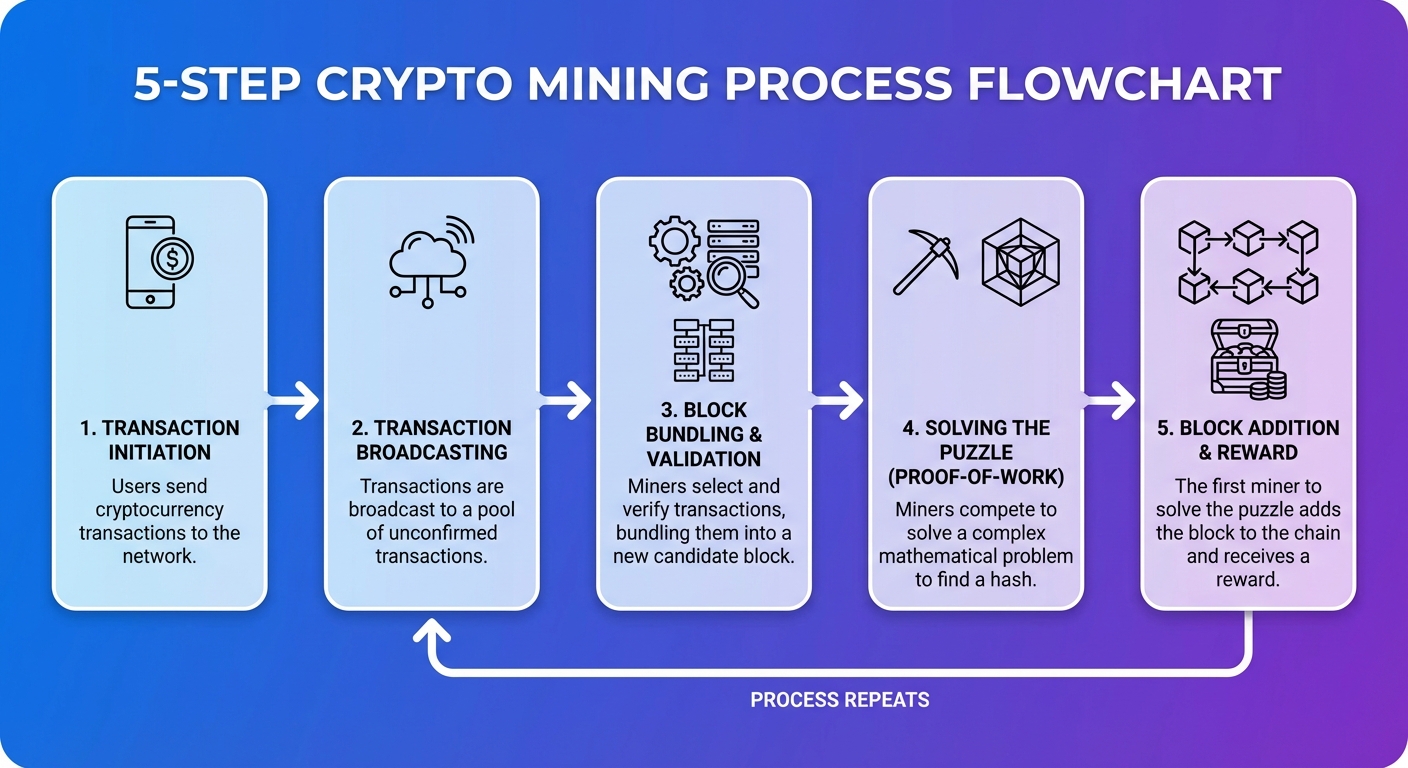
Step 1: Transactions Enter the Mempool
When users send cryptocurrency, their transactions go into a waiting area called
the mempool (memory pool). Miners pick transactions from here.
Step 2: Miner Builds a Candidate Block
The miner selects transactions (usually prioritizing those with higher fees) and
assembles them into a candidate block. The block includes:
Selected transactions
The previous block’s hash
A timestamp
A nonce (a number the miner will adjust)
Step 3: The Puzzle – Finding the Right Hash
The miner must find a hash for the block that starts with a certain number of
leading zeros. This is controlled by the difficulty target.
For example, the miner needs to find a hash that looks like:
The miner keeps changing the nonce and recalculating the hash until they find
one that meets the difficulty requirement. This requires trillions of attempts!
Step 4: Block is Broadcast
Once a miner finds a valid hash, they broadcast the new block to the network.
Other nodes verify that the hash is correct and the transactions are valid.
Step 5: Block is Added & Reward is Paid
If the network accepts the block, it’s permanently added to the chain.
The successful miner receives the block reward (currently 3.125 BTC for Bitcoin)
plus all the transaction fees from the included transactions.
💻 Mining Hardware Evolution
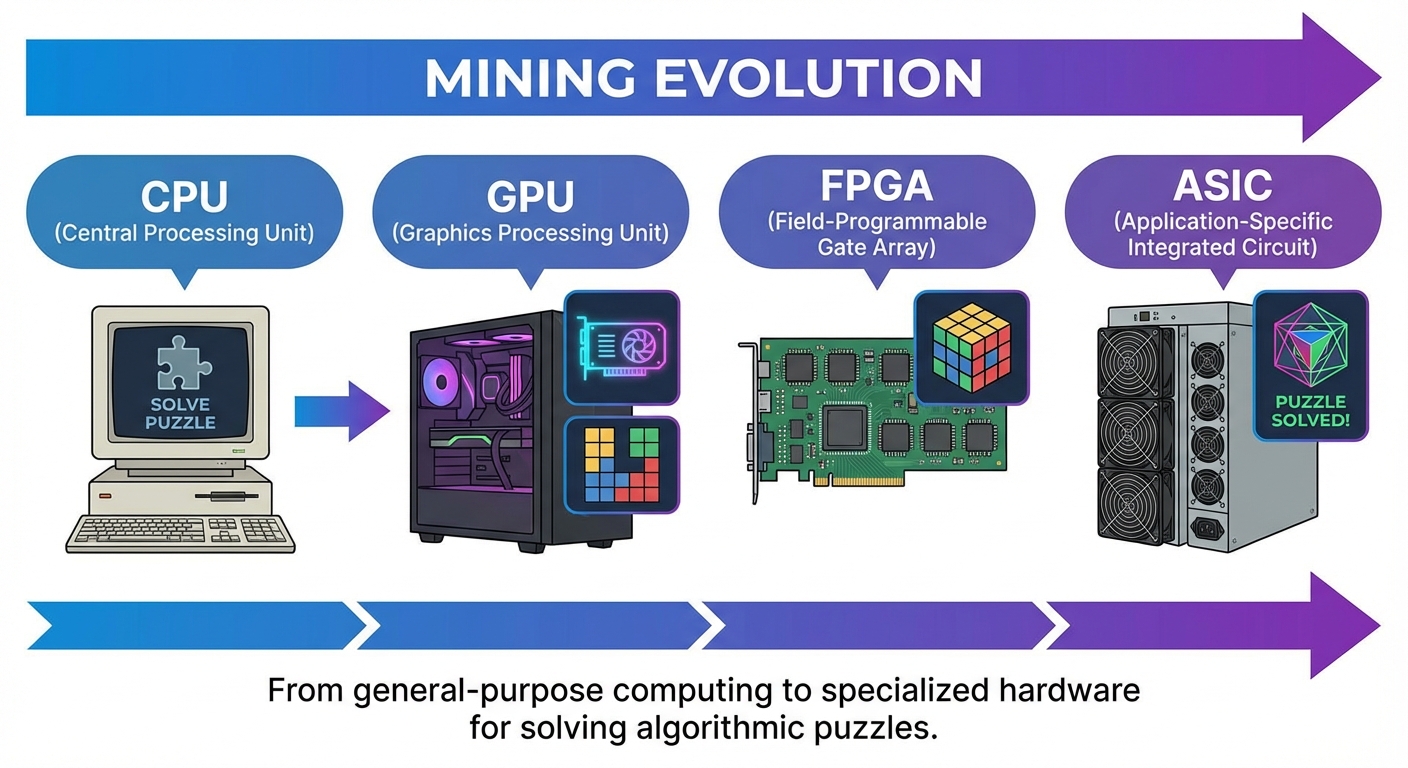
Mining hardware has evolved dramatically since Bitcoin’s early days:
Mining Hardware Through the Ages
Era
Hardware
Hash Rate
Power Usage
Era Years
💻 CPU Mining
Regular computer processors
~10 MH/s
Low
2009–2010
🎮 GPU Mining
Graphics cards (gaming GPUs)
~800 MH/s
Medium
2010–2013
⚡ FPGA Mining
Field-Programmable Gate Arrays
~1 GH/s
Medium
2011–2013
🔥 ASIC Mining
Application-Specific Integrated Circuits
~100+ TH/s
High
2013–present
MH/s = Mega hashes per second |
GH/s = Giga hashes per second |
TH/s = Tera hashes per second
Figure: From CPUs to ASICs – the evolution of mining hardware💡 What is an ASIC?
An ASIC is
a microchip designed for one specific task—in this case, mining
cryptocurrency. Unlike a CPU or GPU that can do many things, an ASIC does only
one thing but does it incredibly fast. A single modern ASIC
can perform over 100 trillion hash calculations per second!
👥 Mining Pools
As mining became more competitive, individual miners found it nearly impossible
to win the block reward alone. The solution? Mining pools!
How Mining Pools Work
Miners join a pool and combine their computing power
The pool works together to solve blocks faster
When the pool finds a block, the reward is split among all members
Each miner receives a share proportional to their contributed hash power
Solo Mining vs Pool Mining
Aspect
Solo Mining
Pool Mining
Chance of reward
Very low (but full reward if lucky)
Regular small payouts
Required hardware
Massive (impractical for most)
Can start with less
Income stability
Highly unpredictable
Steady and predictable
Fees
None
Pool charges 1-3% fee
Major Mining Pools (Bitcoin)
Foundry USA – Largest Bitcoin mining pool
AntPool – Operated by Bitmain
F2Pool – One of the oldest pools
ViaBTC – Multi-coin mining pool
Binance Pool – Run by the Binance exchange
💰 Mining Rewards & Economics
Miners earn money from two sources:
1. Block Reward
New coins are created with each block. For Bitcoin, this reward
halves every ~4 years.
Currently: 3.125 BTC per block (since April 2024).
2. Transaction Fees
Users pay fees to have their transactions included in a block.
Higher fees = higher priority. Miners collect all fees in their block.
Mining Profitability Factors
Factor
Impact
Electricity cost
The biggest expense – cheaper power = more profit
Hardware efficiency
Better ASICs use less power per hash
Bitcoin price
Higher price = more value per block reward
Network difficulty
More miners = harder puzzles = less chance of winning
Cooling costs
Mining hardware generates significant heat
💡 What is Mining Difficulty?
The Bitcoin network automatically adjusts how hard the mining puzzle is
every 2,016 blocks (~2 weeks). If miners are finding blocks too fast
(under 10 minutes average), difficulty increases. If too slow, it
decreases. This ensures blocks are found roughly every 10 minutes,
regardless of how much computing power is on the network.
⚡ The Energy Debate
One of the biggest criticisms of Proof of Work mining is its energy consumption.
Bitcoin mining uses more electricity than some entire countries.
Bitcoin Energy Consumption
Bitcoin vs Country Energy Use (Annual)
Entity
Annual Energy Use (TWh)
🇳🇴 Norway
~124 TWh
⛏ Bitcoin Network
~150 TWh
🇦🇷 Argentina
~130 TWh
🇳🇱 Netherlands
~110 TWh
Arguments For & Against
✅ Arguments For Mining
❌ Arguments Against Mining
Securing a trillion-dollar network
Enormous carbon footprint
Incentivizes renewable energy
E-waste from outdated hardware
Uses otherwise wasted energy
Drives up energy costs locally
Most decentralized consensus method
More efficient alternatives exist (PoS)
🌱 The Proof of Stake Alternative
Proof of Stake (PoS) is an alternative consensus mechanism that
doesn’t require mining at all. Instead of solving puzzles, validators
lock up (stake) their coins as collateral.
How Staking Works
Validators deposit cryptocurrency as a “stake”
The network randomly selects a validator to create the next block
Validators with more coins staked have a higher chance of being selected
If a validator tries to cheat, their stake is “slashed” (destroyed)
Honest validators earn staking rewards
Learn more about consensus mechanisms on our
How It Works page.